Is It Possible to Never Sleep Again
What If We Didn't Demand Sleep?
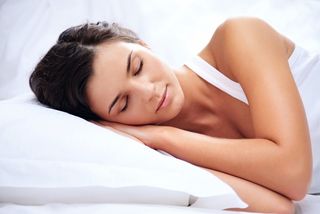
If you've ever pulled an all-nighter, you know y'all're not yourself the next day. And perhaps yous've fifty-fifty lamented the demand for 8 hours of shut-eye.
But what if there were a cure for slumber? What if there were a drug y'all could take and so you never felt tired? After all, researchers are working on drugs to prevent sleepiness — a 2007 report institute that a nasal spray containing the hormone orexin-A reversed the effects of sleep impecuniousness in monkeys.
Fifty-fifty so, experts say slumber plays a fundamental function in how people construction their lives, and taking it away would have a large sociological bear upon.
"People don't realize what a reciprocal relationship we have with slumber," said Mairead Eastin Moloney, a medical sociologist and assistant professor of sociology at the University of Kentucky. "Sleep really structures our lives," and we too structure our sleep around our social globe, Moloney said. [What If? 22 Crazy Hypothetical Questions (and Their Answers)]
Here are some ways human lives might be different if there were a cure for slumber.
More productive?
Many people call up they would be more productive if only they had more than time. Then in a world without sleep — in which people had 8 more hours in a day — it'southward tempting to propose they'd go more than done, and gild would solve more than bug. But experts say virtually people would non make the all-time employ of this extra fourth dimension.
"It'due south really seductive to call back we would all become smarter and more than productive, merely that'south not necessarily the example," Moloney said.
The homo brain requires a certain amount of downtime to function optimally, and as well much work or stress impairs thinking, Moloney said. That's why people may come up with their all-time ideas in the shower, or in the middle of a seemingly mindless pastime.
Linda Sapadin, a psychologist in individual practice in New York, agreed. "Most people are not more productive," if they have more than fourth dimension, Sapadin said.
When people accept actress time, they tend to fill information technology with relaxation, or but pass the time away, Sapadin said. "We're not machines," so nosotros tin't simply go on working 24/7, she said. People who are compulsive workers might exercise more at showtime, but "eventually [the work] would have its toll, because nosotros need to refresh ourselves," she said.
Rather than being more productive, people might just be busier. Technological advances over the last few decades have allowed people to work around the clock, Moloney noted, merely they aren't necessarily more than productive than in the by — they're but busier.
"Sleep actually puts a pause on our busyness and our productivity," Moloney said. Without slumber, "I would exist curious to see if we would spiral into busier and busier patterns."
Changes in work schedules
Expectations around work might change likewise. Without a need for sleep, your boss might be justified in wondering why you didn't reply to an e-mail at 3 a.m.
Taking away sleep "shifts expectations of how long people can work for without a interruption," said Catherine Coveney, a inquiry young man in global health at the University of Sussex in the United Kingdom.
As part of a inquiry project, Coveney asked people in different professions what they thought would happen if there were a drug to replace sleep. She found that people who worked day every bit well equally night shifts (such as doctors, nurses and police officers) were concerned well-nigh the thought. "They were worried most exploitation and employers putting pressure on their employees to work longer hours and do more than shifts in the name of economic productivity, where socially and healthwise, workers would lose out," Coveney said.
Society would also demand more than staff in service professions, such as police force officers and firefighters, Moloney said. Fifty-fifty though there are dark-shift workers now, order would demand more than, because people would be more than active at night, Moloney said.
What would you lot practice if you lot didn't have to sleep?
Relationship issues
A cure for sleep would too likely affect relationships. Although people like to spend fourth dimension with loved ones, too much time with their kids or significant other could have a downside.
"If anybody's awake and agile, when do y'all become reanimation, when do yous get a break from your intimates?" Moloney said. "People get a piffling worn out," if they don't have time away from their loved ones — something that sleep usually brings, she added.
On the other hand, some people might lose out on interactions with their family if routines that are congenital around sleep, similar reading to kids before bed, disappear.
"We might lose things like mealtimes and family unit time [and] routines around bedtime," Coveney said.
Economical impact
Although the elimination of slumber would provide more opportunity to make money, information technology would also offer more opportunities to spend money. For case, people would need to heat their homes 24 hours a day and consume more than meals, Coveney said. "A world without sleep would demand more resources to keep information technology running," she said.
In that location's also a question of what would happen to the sleep industry — Americans spend $five billion a year on sleeping aids, Moloney said.
"We have all these ways in which we basically have formed a private economy around sleep that would disappear," Moloney said.
Wellness implications
Forgoing slumber might also have health implications. Sleep issues take been linked with a number of health atmospheric condition, including obesity and heart affliction. Even if there were a drug that allowed people to function without sleep, that would not necessarily take abroad the risk of these other health conditions linked with a lack of sleep, Moloney said.
In add-on, at that place would be more than opportunities to swallow, which could lead to increases in obesity, Moloney said. While at that place would theoretically also exist more fourth dimension to get to the gym, humans tend to gravitate toward things that bring pleasure, she said.
"Even when people really do have the time to make healthy choices, a lot of times, well-nigh of usa don't," Moloney said.
Sleep is besides important for retentivity consolidation, said Dr. Abid Malik, medical managing director of the South Seminole Hospital Sleep Disorders Center at Orlando Health in Florida. So even if people don't feel tired, a lack of sleep can bear on their brains, Malik said. It's unclear what the long-term consequences of taking drugs to stay awake might be, he added.
Follow Rachael Rettner @RachaelRettner. Follow Live Science @livescience , Facebook & Google+ . Original commodity on Alive Scientific discipline.

Rachael has been with Alive Scientific discipline since 2010. She has a master's caste in journalism from New York University's Scientific discipline, Wellness and Environmental Reporting Program. She too holds a B.S. in molecular biology and an Chiliad.Southward. in biology from the Academy of California, San Diego. Her work has appeared in Scienceline, The Washington Postal service and Scientific American.
benjaminthativess40.blogspot.com
Source: https://www.livescience.com/48465-what-if-cured-sleep.html
0 Response to "Is It Possible to Never Sleep Again"
Enviar um comentário